Scabies Mites
(Itch mite, Sarcoptic mite, Norwegian scabies mite)*Sarcoptes scabiei*
Identification & Appearance
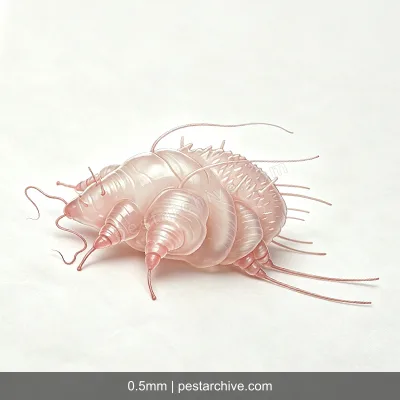
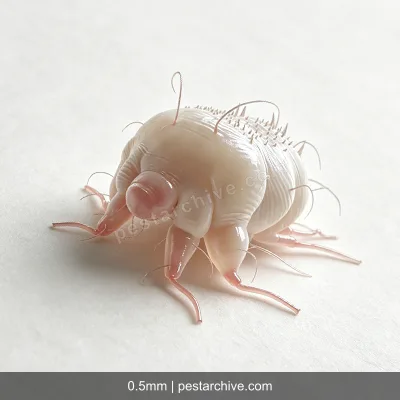
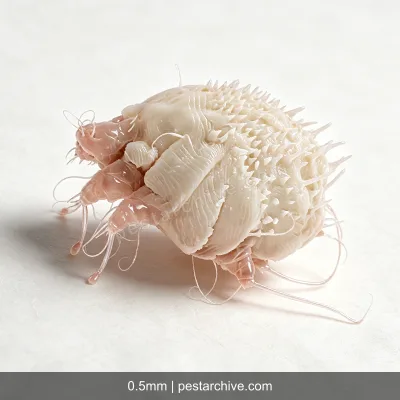
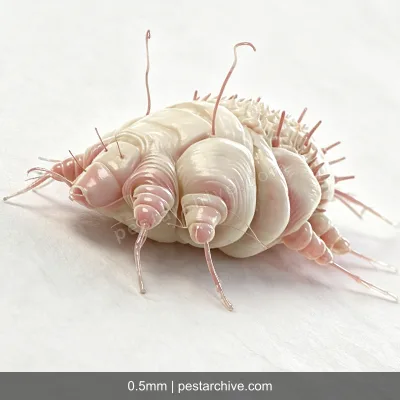
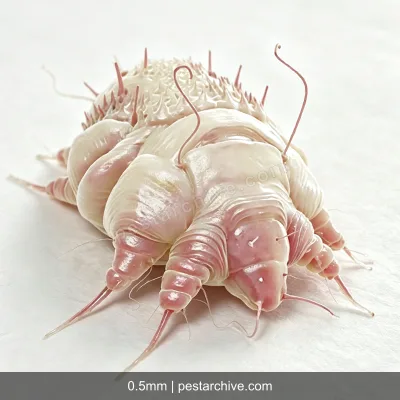
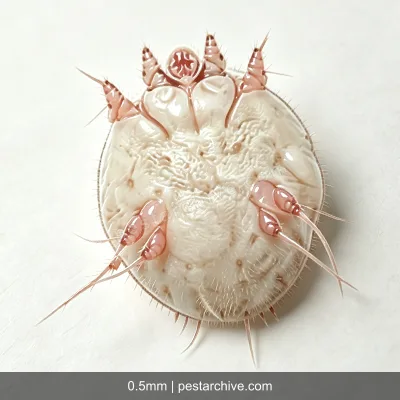
Scabies mites (Sarcoptes scabiei var. hominis) are obligate parasites that live within human skin, belonging to the family Sarcoptidae. Adult mites measure only 0.3-0.5mm — barely visible as a pinpoint dot — with a creamy white or pale yellow rounded body, four pairs of short legs with suckers or long bristles at the tips. Their mouthparts are adapted for chewing into the skin's stratum corneum and burrowing within the epidermis. Scabies mites complete their entire life cycle on the host — the female burrows into the stratum corneum to lay eggs. After hatching, larvae emerge onto the skin surface, developing into nymphs and adults. The egg-to-adult cycle takes about 10-14 days. Males die shortly after mating; females live about 4-6 weeks. Off the human body, scabies mites survive 2-3 days at room temperature but die quickly at temperatures above 60°C or below 0°C. Scabies is recognized by WHO as a neglected tropical disease, with an estimated 200 million cases globally each year.
Habits & Hiding Places
Scabies mites are transmitted through direct or indirect contact — they do not naturally breed in the home environment. Inside the home, scabies transmission and spread occurs primarily through: mattresses and bed frames (the infected person's bedding harbors large numbers of mites and eggs — a key indirect transmission route); sofas and cushions (furniture in close skin contact with the infected person can retain mites); wardrobes and clothing storage (worn clothing, towels, and bed sheets can be contaminated); and baseboards and under-furniture areas (corners where mites survive for 2-3 days off the host). Scabies mites are more active in warm, humid conditions and survive for shorter periods in cold, dry environments. Critically, mites remain infectious for 2-3 days after leaving the host — therefore, all clothing, bedding, and towels used by the infected person must be washed in water above 60°C or sealed and isolated, otherwise reinfection is highly likely.
Health Risks & Damage
- Mite burrowing and fecal deposits within the skin cause intense itching, characteristically worse at night (mites are more active nocturnally, and body warmth intensifies the skin reaction). Itching is most severe in skin folds and thin-skinned areas — finger webs, inner wrists, elbow creases, armpits, groin, waist, and buttocks — severely disrupting sleep and daily life.;
- Scabies is highly contagious, spreading rapidly among family members, intimate contacts, and people in group living settings (dormitories, nursing homes, childcare facilities). A single infected person can quickly transmit to the entire household and close contacts without prompt isolation and treatment.;
- Persistent scratching leads to skin breakdown and secondary bacterial infection (impetigo, folliculitis, even cellulitis). A severe variant — crusted (Norwegian) scabies — presents with widespread hyperkeratosis and scaling, is more severe clinically, and is far more contagious. It typically occurs in people with weakened immune systems.;
- Successful scabies management requires concurrent medical treatment (topical scabicides such as permethrin cream or sulfur ointment) AND environmental treatment (high-temperature laundry, household bug-spray treatment). Missing either component will likely lead to relapse and reinfection.
Season & Region
Cosmopolitan. Transmission facilitated in crowded, low-hygiene settings; winter indoor crowding increases transmission risk.
| Region | Active Period | Peak Season | Notes |
|---|---|---|---|
| Global Temperate | Year-round | Autumn–Winter | Indoor crowding in winter elevates transmission risk |
| Global Subtropical to Tropical | Year-round | No distinct seasonal peak | Year-round transmission possible |