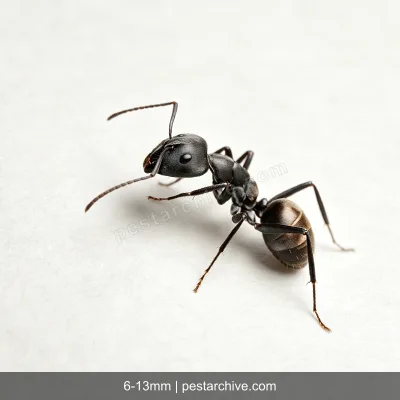
Ants
(Sugar ants, Pavement ants, Odorous house ants)*Monomorium pharaonis* / *Tetramorium caespitum*
Identification & Appearance
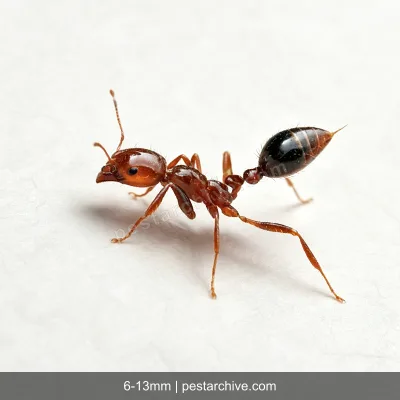
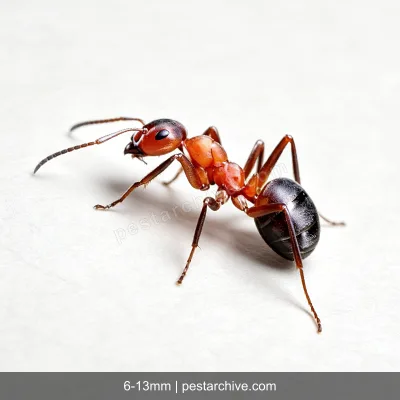
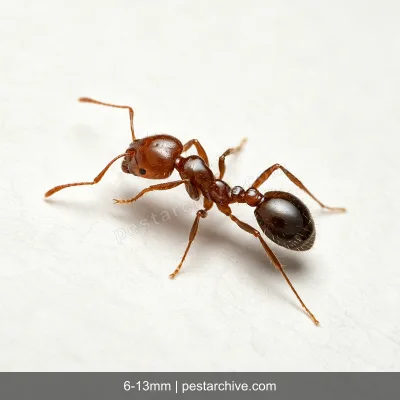
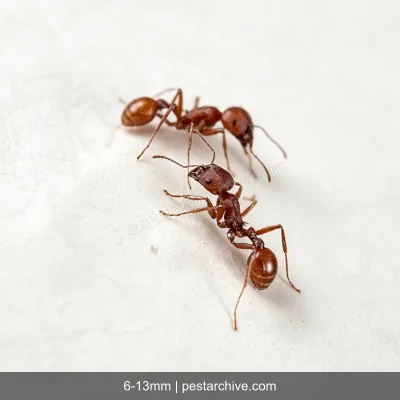
Ants are social insects that live in colonies that can number from a few hundred to millions of ants. The most common household-invading species include carpenter ants (Camponotus spp., 6-13mm, black or red-black), odorous house ants (Tapinoma sessile, 2-3mm, dark brown), pavement ants (Tetramorium immigrans, 2-3mm), and the notorious invasive fire ant (Solenopsis invicta, 2-6mm, reddish-brown). All ants have the classic three-segmented body, elbowed antennae, and a narrow waist between thorax and abdomen. Winged reproductive ants (alates) emerge seasonally for mating flights — these are often mistaken for termites by homeowners.
Habits & Hiding Places
Ants leave chemical pheromone trails between food sources and the nest, creating the characteristic marching lines seen along baseboards and countertops. Most household ants nest outdoors in soil, under stones, or in rotting wood, entering homes solely to forage. Carpenter ants excavate galleries in moist wood but do not eat it — they feed on insects, honeydew, and food scraps. Pharaoh ants (Monomorium pharaonis, 1.5-2mm, yellow-brown) are a significant concern in hospitals because their tiny size allows them to access sterile supplies and wounds. Indoor-nesting species build colonies inside wall voids, under floors, behind cabinets, and inside insulation. Some species form supercolonies with multiple queens spanning kilometers.
Health Risks & Damage
- Food contamination: ants trailing through kitchens and pantries mechanically transfer bacteria to food and surfaces.;
- Carpenter ants tunnel through wood, causing structural damage over years. Unlike termites, they do not eat wood, but their galleries can weaken beams and framing.;
- Fire ant stings inject alkaloid venom causing immediate burning pain followed by sterile pustule formation. About 1% of people are at risk of anaphylaxis from fire ant venom.;
- Pharaoh ants in hospitals can carry Pseudomonas aeruginosa and other pathogens into sterile areas, wounds, and IV lines.;
- Argentine ants form massive supercolonies that displace native ants and protect agricultural pests like aphids.
Common Species
There are 6 common ant species in households, with significant differences in diet, nesting sites, and aggression levels. Targeted control measures should be species-specific.
Carpenter Ant
Camponotus spp.Workers 6–13mm (polymorphic), black or black-brown. Do not eat wood but excavate nests in damp, decaying wood, which can cause structural damage. Primarily active at dusk and night; feed on insects, honeydew, and food scraps. Winged reproductives swarm April–June.
Red Imported Fire Ant
Solenopsis invictaWorkers 2–6mm, reddish-brown to dark reddish-brown. Extremely aggressive; bite with mandibles while curling body to sting repeatedly with abdominal stinger, injecting venom that causes intense burning sensation and white pustule formation. Nest underground, forming visible soil mounds. About 1% of people risk life-threatening anaphylaxis from the venom.
Pharaoh Ant
Monomorium pharaonisWorkers only 1.5–2mm, yellow to yellowish-brown, antennae with terminal 3 segments enlarged into a club. Extremely small body allows entry into any crevice. Serious pest in hospitals; can transmit Pseudomonas aeruginosa and other pathogens. Never use repellent insecticide sprays, as this causes colony fragmentation and spread.
Odorous House Ant
Tapinoma sessileWorkers 1.6–3mm, dark brown to black. When crushed, releases a distinctive odor reminiscent of rotten coconut. Often forms conspicuous trails along walls; strongly prefers sweets and sugary substances.
Pavement Ant
Tetramorium immigransWorkers 2–3mm, dark brown to black, head and thorax with distinct longitudinal grooves. Often nests in pavement cracks and gaps; most common around building foundations and sidewalks. Winged reproductives swarm May–July.
Argentine Ant
Linepithema humileWorkers 2–3mm, light brown to dark brown, thorax dorsal surface smooth without spines. Can form supercolonies spanning thousands of kilometers; among the most aggressive invasive ant species. Tends aphids for honeydew, indirectly harming plants.
Season & Region
Cosmopolitan. Main foraging and activity season spring–summer (Mar–Oct); peak May–Aug. Activity declines in low winter temperatures but year-round in heated indoor environments. Mass relocation ("ant relocation") common after rain. Optimal temperature 15–35 °C.
| Region | Active Period | Peak Season | Notes |
|---|---|---|---|
| N. Hemisphere Temperate | Apr–Oct | May–Aug | Spring–summer peak; winter decline |
| N. Hemisphere Subtropical | Mar–Nov | May–Sep | Intense activity around rainy periods |
| Tropical | Year-round | Rainy season | Year-round reproduction; highest density in rainy season |