Drain Flies
(Moth flies, Sewer flies, Filter flies)*Clogmia albipunctata* / Psychodidae
Identification & Appearance
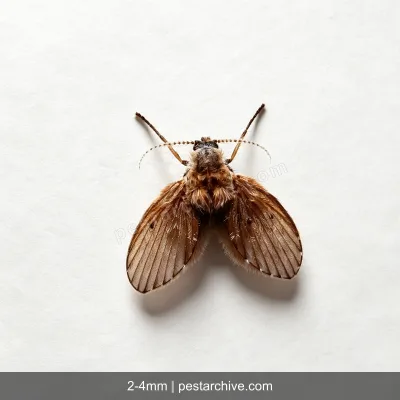
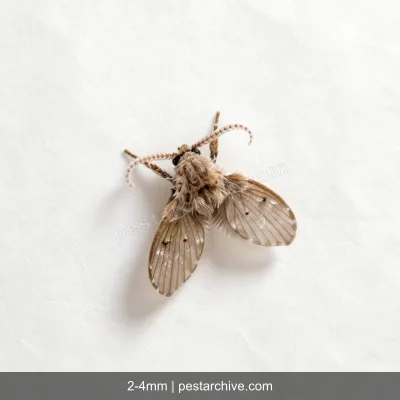
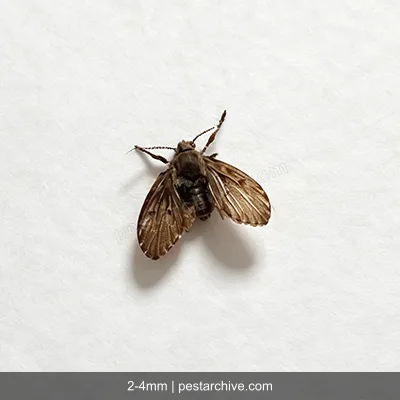
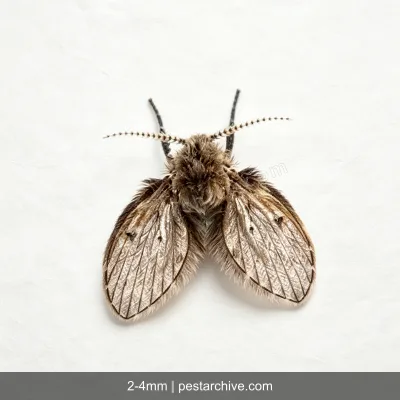
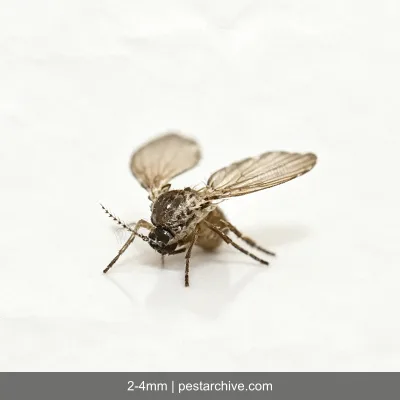
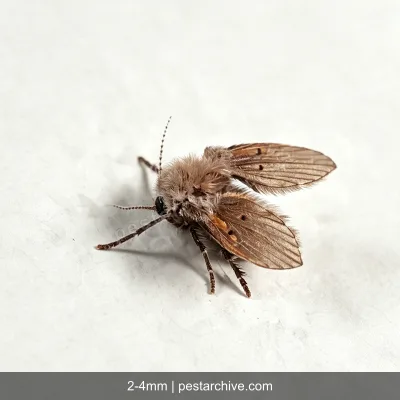
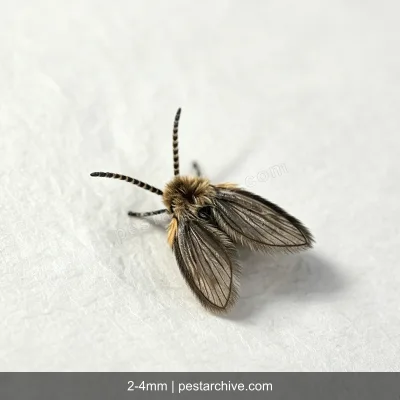
Drain flies (family Psychodidae), also called moth flies or filter flies, are the most common tiny flying pests of bathrooms and damp areas. Adults measure 2-4mm, gray-brown to dark gray, with bodies and wings densely covered in hairs. The wings are broad and oval, held roof-like over the body at rest, giving them a tiny moth-like appearance. Larvae measure 4-6mm, slender, gray-white, with a breathing tube at the rear. They live in the biofilm (slime layer) inside drain pipes, feeding on bacteria, fungi, and organic grime. At 22-28 C, the cycle takes 2-4 weeks. Adults live about 2 weeks and are weak fliers. Complete elimination requires removing the pipe biofilm.
Habits & Hiding Places
Drain fly larvae develop in the biofilm coating the inside of drain pipes, feeding on organic grime. Indoors, they concentrate around bathroom floor drains and sink drains (primary breeding sites — hair, skin oils, soap scum, and microorganisms form biofilm), toilet base-floor joints (splash water accumulates, forming biofilm), and under-sink drain pipe joints (leaks and condensation support breeding). Adults rest on bathroom walls and mirrors. They are poor fliers, moving in short hopping flights. They do not bite. Activity peaks at dusk and night. Infrequently used bathrooms (e.g., guest bathrooms) are more prone to infestations because reduced water flow allows stable biofilm accumulation.
Health Risks & Damage
- Adults resting and crawling on bathroom walls, mirrors, and counters affect hygiene and comfort. Dozens can appear in a single bathroom.;
- Their hairy bodies and legs can carry bacteria from drains to personal items like toothbrushes, towels, and cups.;
- When they spread to kitchens and living areas, they create food hygiene concerns.;
- Killing only adults achieves nothing — new adults continuously emerge from pipes. Root solution: clear pipe biofilm with boiling water, pipe cleaners, or enzyme products, and install insect-proof drain covers.
Season & Region
Cosmopolitan in bathroom and kitchen environments. Favors warm, humid conditions (25–32 °C, RH >70 %); under such conditions eggs hatch in 2 days and a complete generation takes only 21 days. Peak occurrence in spring–summer (Apr–Oct); year-round reproduction in southern regions. Larvae develop in the biofilm layer on the inner walls of drain pipes.
| Region | Active Period | Peak Season | Notes |
|---|---|---|---|
| N. Hemisphere Temperate | Apr–Oct | Jun–Sep | Highest summer density; winter decline |
| N. Hemisphere Subtropical to Tropical | Year-round | May–Sep | Year-round occurrence; higher spring–summer density |