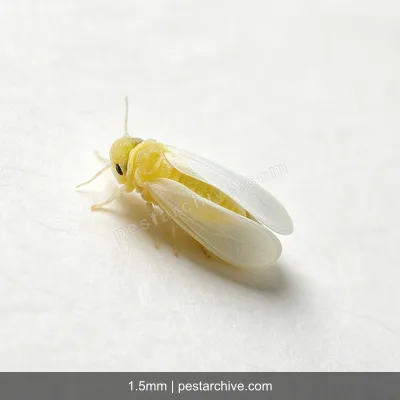
Whiteflies
(Greenhouse whitefly, Silverleaf whitefly, Bemisia)*Trialeurodes vaporariorum* / *Bemisia tabaci*
Identification & Appearance
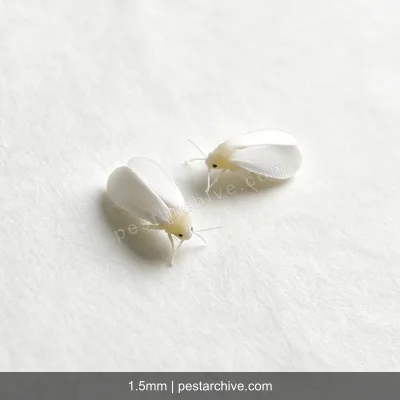
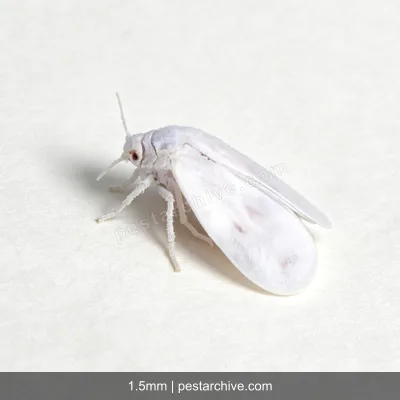
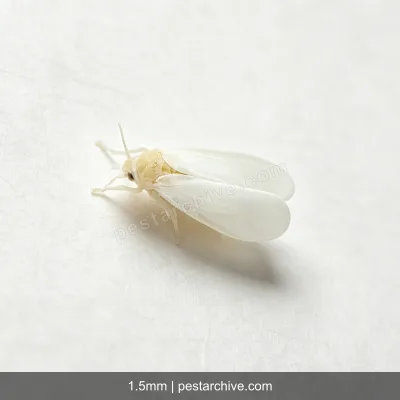
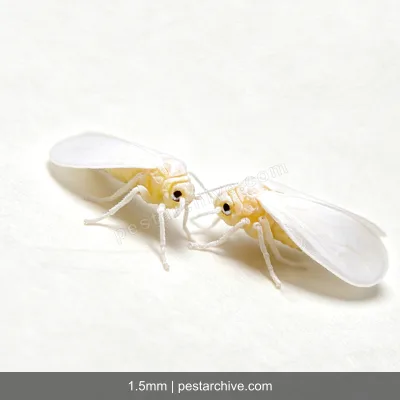
Whiteflies (family Aleyrodidae) are persistent pests of indoor and greenhouse plants. The most common household species is the greenhouse whitefly (Trialeurodes vaporariorum). Adults measure just 1-1.5mm, white to pale yellow, with two pairs of wings covered in white waxy powder. When disturbed, they fly up in a small cloud, then quickly resettle. Nymphs are scale-like, translucent pale green, and immobile once settled. At 22-28 C, the cycle takes 3-4 weeks with 6-10 generations per year. Whiteflies feed on plant sap from an extremely wide host range; they excrete abundant honeydew that promotes sooty mold.
Habits & Hiding Places
Whiteflies feed on plant sap from hundreds of plant species: tomatoes, peppers, eggplants, cucumbers, roses, hibiscus, poinsettias, and pothos. Indoors, all life stages concentrate on leaf undersides. Adults fly up in clouds when disturbed, then resettle on nearby plants. They favor warm, humid, poorly ventilated conditions. Dense plant placement accelerates spread. They breed year-round in heated homes; populations peak in late spring to summer.
Health Risks & Damage
- Adults and nymphs suck sap, causing leaves to yellow, wilt, and drop. Heavy infestations severely weaken plants.;
- Abundant honeydew promotes sooty mold, further weakening plants and ruining ornamental value.;
- Large adult populations fly up in clouds when disturbed, disrupting indoor comfort. Waxy powder and scales in the air trigger allergies.;
- Control is difficult: overlapping generations mean all stages are present simultaneously. Nymphs and pupae have waxy protection against pesticides. Treat 2-3 times at 5-7 day intervals targeting newly hatched nymphs. Yellow sticky traps effectively capture adults.
Season & Region
Cosmopolitan. Overwinters in greenhouses in northern regions; year-round reproduction in southern regions. Optimal temperature 25–30 °C. Spring–summer (Apr–Aug) is the outdoor peak; mass occurrence year-round in greenhouses. Extremely rapid reproduction with pronounced generation overlap.
| Region | Active Period | Peak Season | Notes |
|---|---|---|---|
| N. Hemisphere Temperate | Apr–Oct(Open ground) | May–Aug | Year-round in greenhouses; spring–summer outdoor peak |
| N. Hemisphere Subtropical to Tropical | Year-round | May–Sep | Mass occurrence year-round |