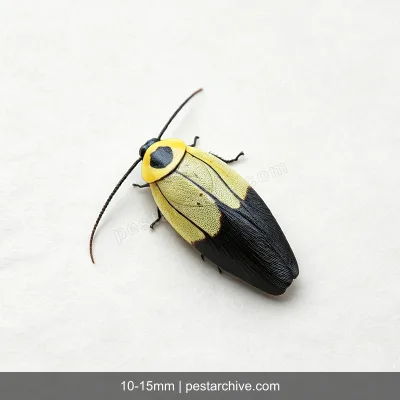
Cockroaches
(German cockroach, American cockroach, Palmetto bug)*Blattella germanica* / *Periplaneta americana*
Identification & Appearance
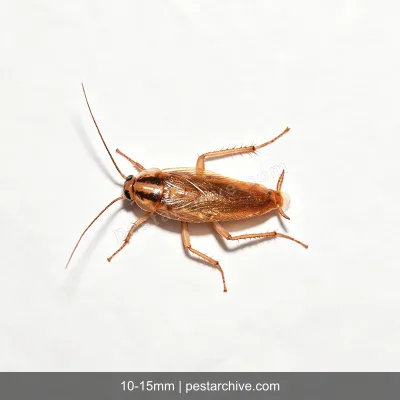
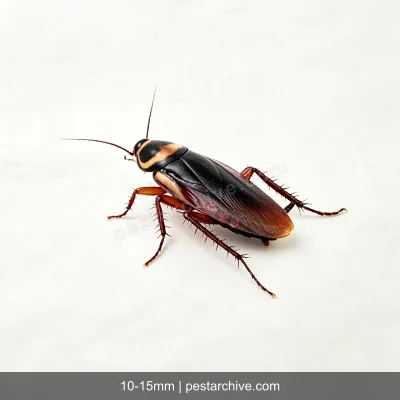
Cockroaches are among the most persistent and reviled household pests worldwide. The most common indoor species are the German cockroach (Blattella germanica, 10-15mm), the smokybrown cockroach (Periplaneta fuliginosa, 20-30mm), and the American cockroach (Periplaneta americana, 30-40mm). Adults have flattened oval bodies, brown to black coloration with a glossy sheen, small heads with chewing mouthparts, long threadlike antennae, and well-developed legs adapted for rapid running. The pronotum (the shield behind the head) bears species-specific markings — German cockroaches have two dark longitudinal stripes. Cockroaches undergo incomplete metamorphosis: egg (encased in an ootheca), nymph, and adult. A single ootheca can contain 20-40 eggs. Under ideal conditions, German cockroaches can complete a generation in 2-3 months, with a single pair theoretically producing hundreds of thousands of descendants in one year.
Habits & Hiding Places
Cockroaches are primarily nocturnal, emerging at night to forage and retreating into crevices during daylight. German cockroaches strongly prefer warm, humid indoor environments — kitchens and bathrooms are their primary strongholds, where they aggregate inside appliances (refrigerators, dishwashers, microwaves), under sinks, and inside cabinet voids. American and smokybrown cockroaches are more common in sewers, basements, and outdoors in warmer climates. Cockroaches are thigmotactic — they prefer tight contact with surfaces on both sides of their body, which is why they squeeze into impossibly narrow cracks. They are omnivorous scavengers, feeding on virtually any organic matter including food scraps, grease, soap, glue, and even each other's feces and carcasses. German cockroaches require water sources and are therefore found near plumbing.
Health Risks & Damage
- Cockroaches mechanically transmit at least 33 species of bacteria (including E. coli and Salmonella), 6 species of parasitic worms, and multiple human pathogens. They walk through filth and then across food preparation surfaces, dishes, and utensils.;
- Cockroach allergens — proteins in their saliva, feces, shed skins, and body fragments — are a leading trigger of asthma, especially in children. Inner-city asthma rates are strongly correlated with cockroach allergen exposure.;
- Cockroaches reproduce explosively. A single female German cockroach produces 4-8 oothecae in her lifetime, each containing 30-40 eggs. Nymphs reach reproductive age in 6-12 weeks. Without control, a minor introduction can become a severe infestation within months.;
- Cockroaches produce a distinctive oily, musty odor that permeates infested areas and can contaminate food with their feces and secretions.
Common Species
There are 7 common cockroach species in households, varying in morphology, habitat preference, and reproductive rate. Accurate species identification helps target control measures.
German Cockroach
Blattella germanicaBody length 12–15mm, light caramel brown, pronotum with two distinct longitudinal black stripes. Fastest reproduction; each ootheca contains 30–40 eggs; female carries ootheca until hatching. Prefers warm, humid environments; most common in kitchens and bathrooms. The dominant indoor cockroach species.
American Cockroach
Periplaneta americanaBody length 35–41mm, reddish-brown, with a yellow figure-8 pattern behind the head. The largest household cockroach; capable of short-distance flight. Prefers warm, humid, dark environments; commonly found in sewers, basements, and restaurant kitchens.
Oriental Cockroach
Blatta orientalisBody length 25–32mm, dark brown to black and glossy; male wings are short covering only 2/3 of the abdomen; female wings are reduced. Tolerates cold better than other species; prefers damp conditions. Commonly found in basements, drains, and around floor drains, feeding on decaying organic matter.
Brown-Banded Cockroach
Supella longipalpaBody length 10–14mm, smaller than German cockroach, with two distinct light transverse bands on the pronotum and wings. Prefers dry, warm environments; unlike other cockroaches, does not require water sources. Often found on ceilings, in light fixtures, and inside electronics — high locations.
Australian Cockroach
Periplaneta australasiaeBody length 23–35mm, reddish-brown, pronotum with a pale yellow ring surrounding a large black spot, forewing edges with yellow stripes. Tropical/subtropical species; peak activity October–April. Females can lay over 700 eggs in a lifetime.
Smokybrown Cockroach
Periplaneta fuliginosaBody length 30–38mm, uniformly dark brown to reddish-brown and glossy, pronotum smooth without pale edges. Strong flier with pronounced phototaxis. Commonly found around trees (especially palms), wood piles, attics, and basements.
Woods Cockroach
Parcoblatta pensylvanicaBody length 12–25mm, dark brown to black-brown; males have fully developed wings and can fly; females have reduced wings. Primarily lives outdoors in woodlands and wood piles. Occasionally enters homes attracted by lights; does not breed indoors. No chemical control needed.
Season & Region
Cosmopolitan. Favors warm, humid, crevice-rich environments. Activity increases from mid-April; Jul–Sep is the annual peak density period. Activity declines after Oct as temperature drops. Year-round activity in heated indoor environments in northern regions. Optimal temperature 24–32 °C.
| Region | Active Period | Peak Season | Notes |
|---|---|---|---|
| N. Hemisphere Temperate | Apr–Oct | Jul–Sep | *Blattella germanica* dominant; year-round indoor reproduction |
| N. Hemisphere Subtropical | Mar–Nov | May–Sep | *Periplaneta americana* dominant; peak activity May–Oct |
| Tropical | Year-round | Rainy season | Year-round reproduction; no distinct overwintering |