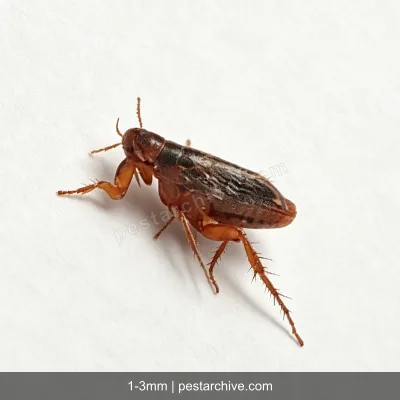
Fleas
(Cat flea, Dog flea, Human flea)*Ctenocephalides felis* / *Pulex irritans*
Identification & Appearance
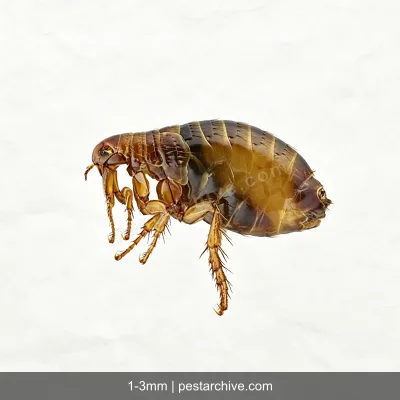
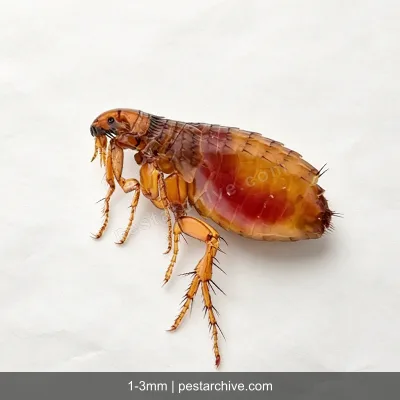
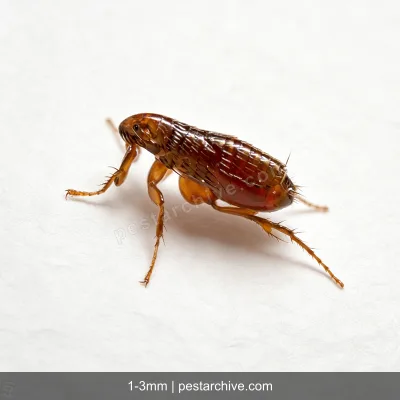
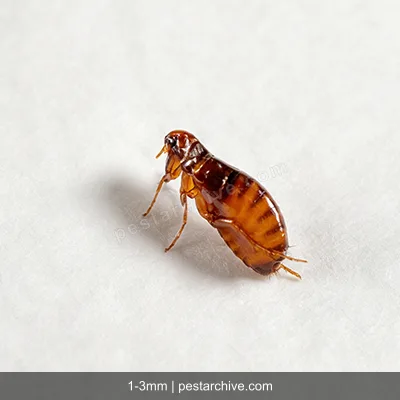
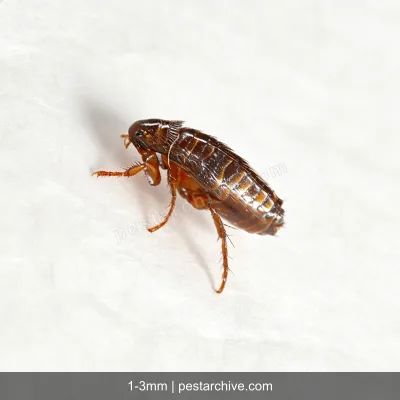
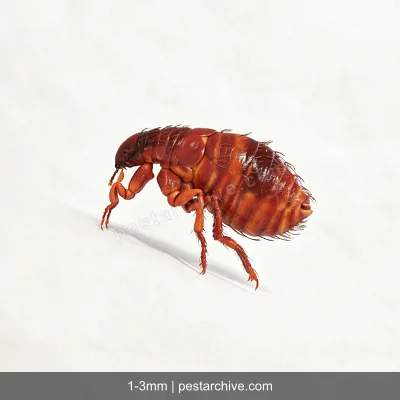
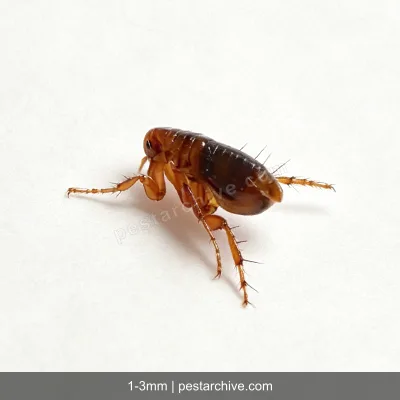
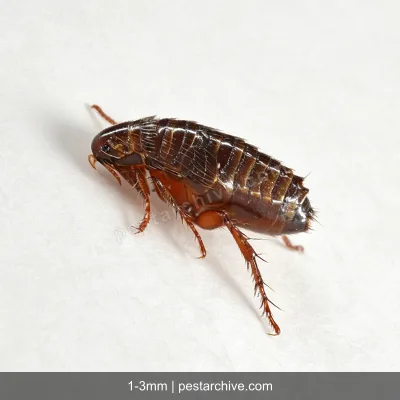
Fleas are among the most common blood-feeding household pests. Adult fleas measure only 1-3mm, with a dark brown to reddish-brown laterally flattened body — an evolutionary adaptation that lets them move easily through host fur and feathers. Though wingless, their powerful hind legs can jump up to 30cm vertically, roughly 100 times their body length. Their piercing-sucking mouthparts are specialized for penetrating skin and feeding on blood. The most common household species are cat fleas (Ctenocephalides felis) and dog fleas (Ctenocephalides canis), with cat fleas being overwhelmingly dominant — they infest cats, dogs, and readily bite humans. Fleas undergo complete metamorphosis: egg, larva, pupa, and adult. Under optimal conditions (21-32°C, 70%+ humidity), the entire cycle from egg to adult takes just 2-3 weeks.
Habits & Hiding Places
Fleas thrive in warm, humid environments, with an optimal temperature range of 21-30°C and relative humidity above 70%. In the home, fleas concentrate where pets spend the most time: the pet bed and a 1-2 meter radius around it is the highest-density zone. Sofas, carpet fibers and crevices, mattress seams, and floor cracks provide ideal hiding and breeding spots. Adult fleas live on the host, but eggs, larvae, and pupae develop in the environment — deep in carpet fibers, floor cracks, and dusty corners. Flea larvae are photophobic (light-avoiding), white, worm-like, about 3-5mm long, and feed on adult flea feces (dried blood) and organic debris. The pupal stage is the key to flea persistence: pupae can remain dormant in their silk cocoons for up to 6 months, emerging when they detect vibrations, warmth, or CO₂ — which is why vacant homes or newly moved-in apartments can suddenly explode with fleas.
Health Risks & Damage
- Flea bites appear as red papules with a visible central puncture point, often arranged in linear or clustered patterns (sometimes called 'breakfast, lunch, and dinner' bites), most commonly found on the lower legs and ankles, but also appearing on the waist, elbows, and armpits. The intense itching can lead to excessive scratching, secondary bacterial infections, and in severe cases, flea allergy dermatitis or cellulitis.;
- Fleas are vectors for several serious pathogens: Yersinia pestis (the bacterium that caused the historic bubonic plague pandemics), Bartonella henselae (cat scratch disease), Rickettsia typhi (murine typhus), and Dipylidium caninum (tapeworm, which can infect children). While plague transmission risk is extremely low in modern urban settings, the vector potential remains a valid concern.;
- Fleas readily transfer between pets and humans. Infested pets show signs of itching, hair loss, skin inflammation, and restlessness. Chronic infestation leads to flea allergy dermatitis (FAD), and in severe cases, iron-deficiency anemia — particularly dangerous for puppies and kittens.;
- A single female flea lays 20-50 eggs per day, producing 200-800 eggs in her lifetime. Under warm, humid conditions, the egg-to-adult cycle takes just 2-3 weeks, enabling explosive population growth.
Common Species
There are 2 main flea species found indoors, with cat fleas accounting for the vast majority of household flea problems.
Cat Flea
Ctenocephalides felisBody length about 3mm, reddish-brown to black, laterally flattened body adapted for moving through fur. Head relatively elongated, hind tibia with 6 notched bristles. The most common household flea species worldwide, parasitizing cats, dogs, and humans; responsible for the vast majority of household flea infestations.
Dog Flea
Ctenocephalides canisBody length similar to cat fleas at about 3mm, anterior head margin noticeably rounded, hind tibia with 8 notched bristles. Less common than cat fleas; even fleas found on dogs are mostly cat fleas.
Season & Region
Cosmopolitan distribution across temperate to tropical zones. Optimal temperature 18–27 °C, RH >70 %. Peak activity occurs in warm, humid seasons.
| Region | Active Period | Peak Season | Notes |
|---|---|---|---|
| N. Hemisphere Subtropical | Mar–Nov | Apr–Jun | Late spring/early summer peak; monsoon season (Meiyu) most intense |
| N. Hemisphere Temperate | May–Oct | Jun–Sep | Summer peak; activity ceases in winter |
| Tropical | Year-round | Rainy season | Year-round reproduction; highest density during rainy season |