Millipedes
(Thousand-leggers, Flat-backed millipedes)Diplopoda
Identification & Appearance
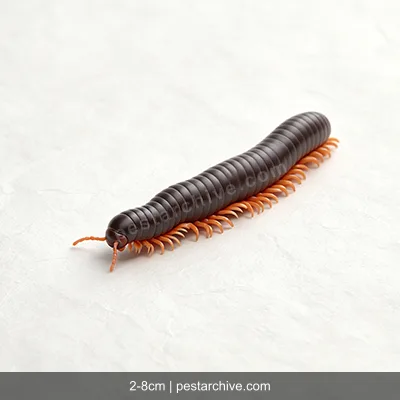
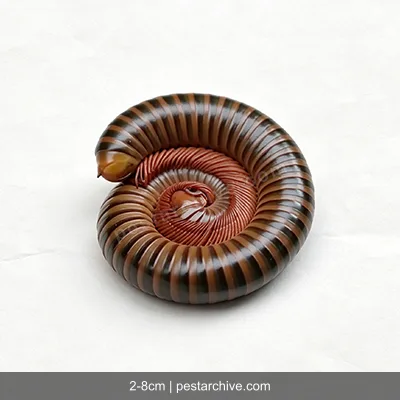
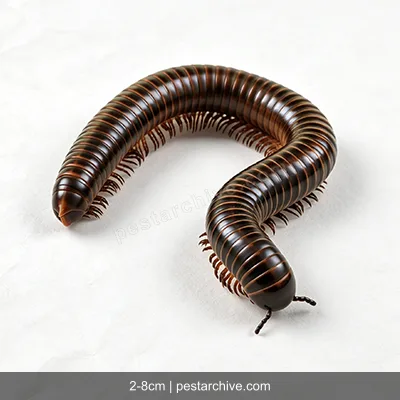
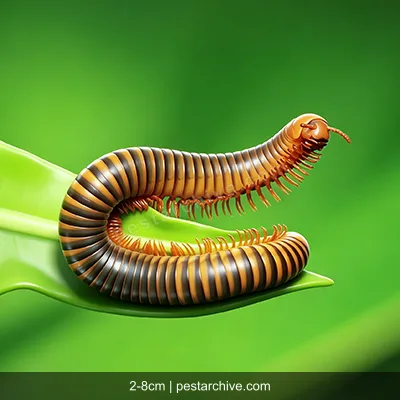
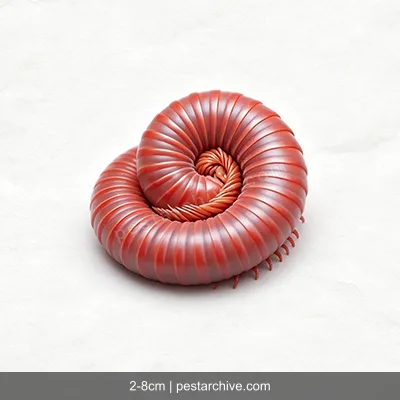
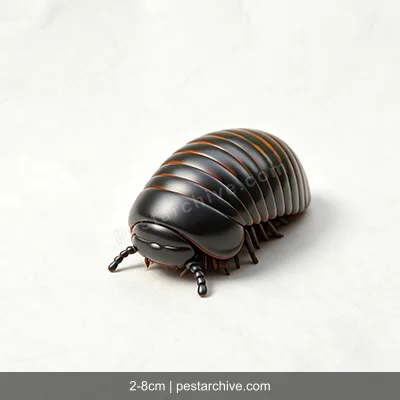
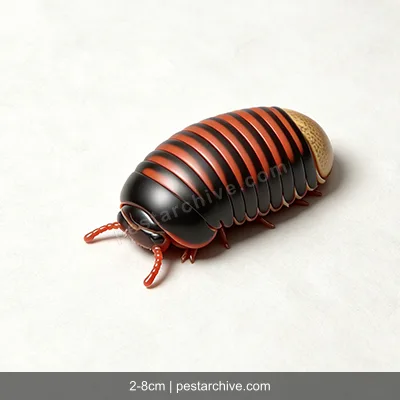
Millipedes, also known as thousand-leggers, belong to the class Diplopoda — with two pairs of legs per body segment (in stark contrast to their centipede relatives, which have one pair per segment). Common household species include Orthomorpha gracilis and Glomeris marginata. Adults measure 2-8cm, with cylindrical or slightly flattened bodies in reddish-brown to deep brown, with 20-70 body segments each bearing two pairs of short, slender legs. The body surface is covered by hardened plates. Millipedes differ from centipedes in several ways: millipedes have cylindrical bodies with short legs (two pairs per segment) and move slowly without aggression; centipedes have flattened bodies with long legs (one pair per segment), move rapidly, and have venomous fangs for active biting. When disturbed, millipedes coil into a tight spiral (not a ball) while secreting an irritating defensive fluid with a distinctive odor from lateral glands. Millipedes develop gradually, molting multiple times from egg to adult over 6-12 months. They feed on decaying plant matter and play a decomposer role in nature. They do not bite or transmit diseases, but their defensive secretion can cause skin irritation. Adults can live 2-5 years — long-lived among household pests. The defensive fluid contains benzoquinones and hydroquinones, which can burn skin or cause staining. Notably, millipedes migrate indoors en masse not only after heavy rain (avoiding flooding) but also during extreme dry spells (seeking moisture).
Habits & Hiding Places
Millipedes favor dark, damp environments and feed on decaying plant matter, leaf litter, and wood debris. Indoors, they are commonly found around: hallway entries and ground-floor wall corners (primary indoor entry routes — after rain, millipedes migrate en masse from landscaping toward buildings, aggregating in hallway corners and wall crevices); balconies and outdoor platforms with stacked flower pots, leaf litter, and clutter (common daytime hiding spots); bathroom and kitchen damp dark corners, laundry rooms (long-damp indoor spaces where millipedes temporarily shelter); and ground-floor and basement baseboard areas (entry from exterior wall cracks). Millipede activity correlates strongly with weather — after heavy rain, they migrate uphill en masse to avoid flooding, appearing in large numbers in hallways and indoors. Millipedes move slowly and cannot climb smooth vertical surfaces, so they primarily travel at ground level. They are sensitive to dryness, seeking damp, dark refuges in dry conditions. Heavy indoor millipede presence usually signals serious outdoor breeding or building moisture-proofing problems. Millipedes are not social, but mass migrations after rain can bring multiple individuals indoors simultaneously.
Health Risks & Damage
- Millipede defensive secretions contain benzoquinone compounds. Skin contact causes redness, blistering, and intense itching, similar to a chemical burn. Eye contact can cause conjunctivitis, potentially requiring medical attention. Wash contacted skin thoroughly with soap and water after handling millipedes.;
- Mass millipede entry (especially after rain) creates disturbing aggregations crawling along walls, corridors, and floors, causing significant psychological distress. Secretion trails and excrement spots left on walls and floors affect indoor cleanliness.;
- Dead millipede bodies decompose, producing odor and attracting other insects (ants, flies). Large millipede aggregations in corners can generate decaying organic matter that also fosters mold growth.;
- Millipedes do not damage building structures, chew furniture or clothing, or bite people or pets. Their impact is primarily limited to psychological discomfort and skin irritation from secretions. The key to millipede control is sealing building gaps, clearing outdoor leaf litter and debris, and improving indoor ventilation and dehumidification.
Season & Region
Cosmopolitan. Strongly hygrophilic. Main active period Jun–Oct, with peak abundance on rainy summer nights. One generation per year; shelter during daytime, active at night. Secretes irritating defensive fluid (quinones) when disturbed.
| Region | Active Period | Peak Season | Notes |
|---|---|---|---|
| N. Hemisphere Temperate | Jun–Sep | Jul–Aug | Highest density after summer rain; burrows into soil after Oct |
| Tropical | Year-round | Rainy season | Longer active season in warm regions |