Jewel Beetles
(Metallic wood-boring beetles, Flatheaded borers, Emerald ash borer)Buprestidae
Identification & Appearance
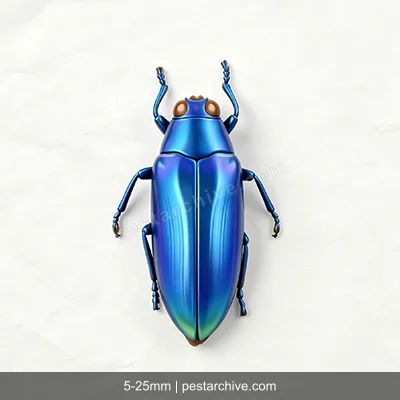
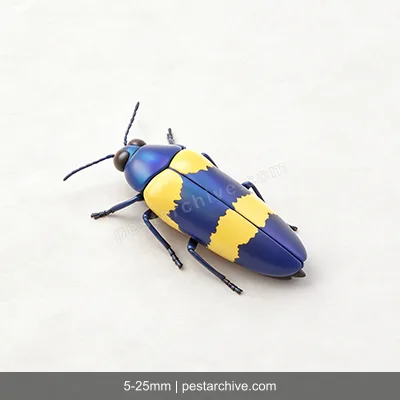
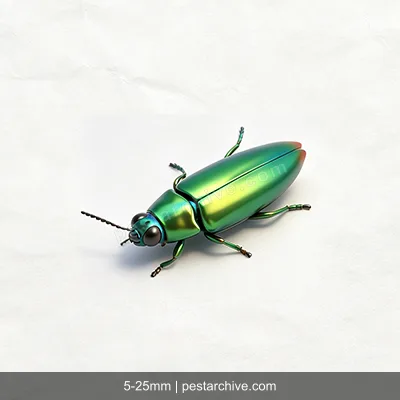
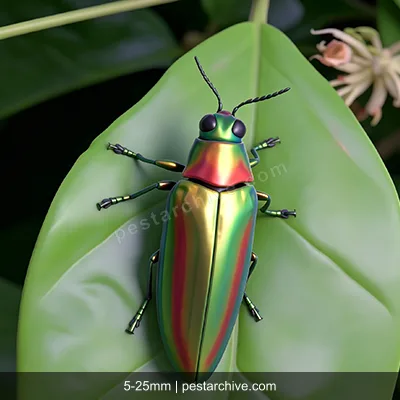
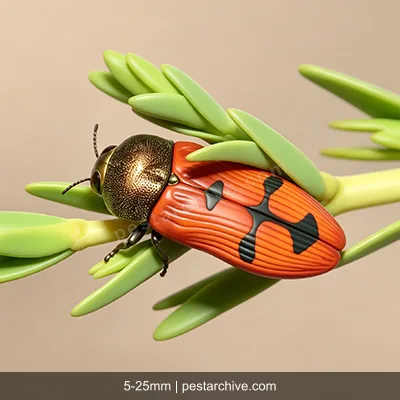
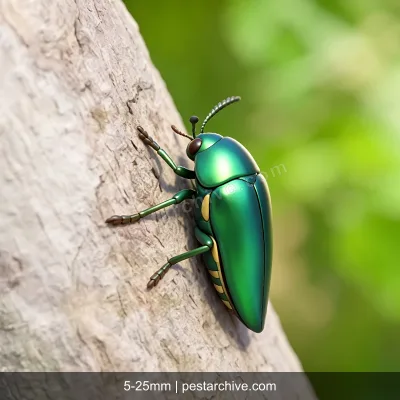
Jewel beetles (family Buprestidae), also called metallic wood-boring beetles, are known for their brilliant metallic colors. Adults measure 5-25mm, elongated and flattened, tapering toward the rear. Elytra display intense metallic green, blue, copper, purple, or gold — hence the name 'jewel beetle.' Larvae measure 10-30mm, white to pale yellow, with a characteristically flattened, expanded thorax. They bore flat, spiraling galleries under tree bark. The emerald ash borer (Agrilus planipennis) is one of the most destructive invasive forest pests in North America, having killed hundreds of millions of ash trees. In Chinese homes, citrus jewel beetles are significant pests of potted citrus and ornamental trees.
Habits & Hiding Places
Jewel beetle larvae bore in the cambium layer between bark and wood. Indoors, they damage balcony potted tree branches (larvae tunnel under bark, causing branch dieback), wood plant stands and railings, and door/window areas (adults attracted to light enter at night). Adults are active in summer, feeding on leaves. They are strong fliers. Ground-floor units near woods, orchards, and landscaping face the highest pressure.
Health Risks & Damage
- Larvae destroy the cambium, cutting off water and nutrient flow. Branches die from the tip downward; entire potted trees can die within 1-2 growing seasons.;
- Adult leaf feeding creates notches; heavy feeding reduces plant vigor.;
- Certain species are catastrophic invasive pests globally.;
- Indoor wood product damage is usually minor — larvae primarily develop in live trees. Main indoor impact: nuisance from adults flying in.;
- Control: prune and destroy infested branches, scrape out larvae under bark before they bore deeper, protect natural parasitoid wasps.
Season & Region
Cosmopolitan. Adults active in summer; phototactic.
| Region | Active Period | Peak Season | Notes |
|---|---|---|---|
| N. Hemisphere Temperate | May–Sep | Jun–Aug | Peak adult emergence and activity in summer |