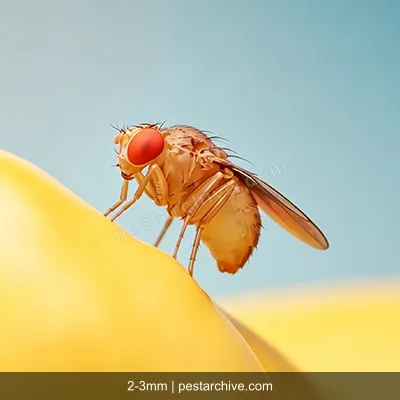
Fruit Flies
(Vinegar fly, Pomace fly, Spotted wing drosophila)*Drosophila melanogaster*
Identification & Appearance
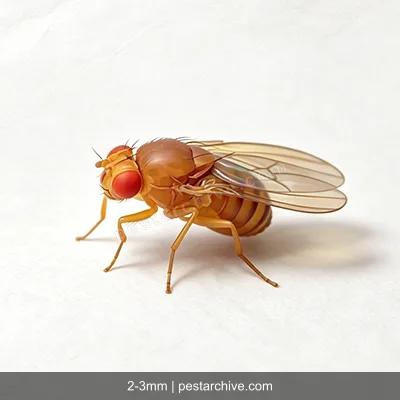
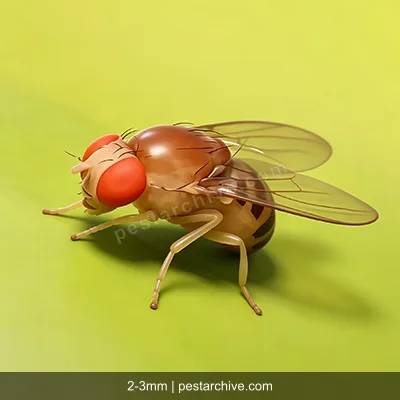
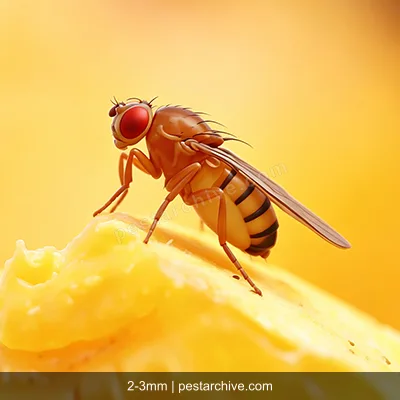
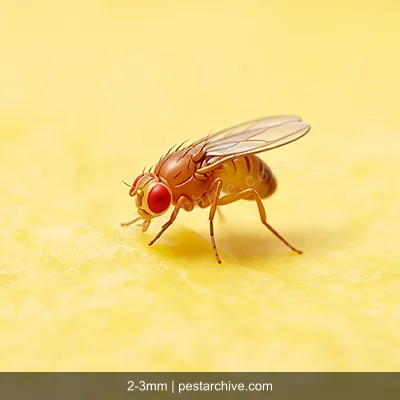
Fruit flies (family Drosophilidae) are the most common tiny flies of summer kitchens. The common species is Drosophila melanogaster — famous as the most important model organism in genetics. Adults measure 2-3mm, yellow-brown to pale yellow, with distinctive bright red compound eyes. At 22-28 C, the egg-to-adult cycle takes just 8-12 days — among the fastest of all household pests — with over 20 generations per year. They are powerfully attracted to the smell of fermentation: overripe fruit, vinegar, wine, and yeast.
Habits & Hiding Places
Fruit flies feed on fermenting sugars and are exquisitely sensitive to the odors of alcohol, vinegar, and rotting fruit. Indoors, they concentrate around fruit bowls and fruit storage (overripe and rotting bananas, apples, grapes, and peaches emit fermentation odors that attract flies from meters away), kitchen trash cans (discarded peels and cores are breeding sources), beverage and wine bottles (fermenting residues attract flies), and kitchen counters and sinks (spilled juice and food residues). They can detect ethyl acetate and other volatile compounds from hundreds of meters away. Populations peak in summer and early autumn; heated homes allow year-round breeding. The short generation time means populations can explode from a few to hundreds within days.
Health Risks & Damage
- Flies lay eggs on fruit, accelerating decay. Yeast and acetic acid bacteria carried on their bodies cause sound fruit to ferment prematurely.;
- Flies hovering around fruit and food disrupt dining. They fall into drinks and food.;
- Their bodies carry microorganisms (yeast, bacteria) that can contaminate food and surfaces.;
- Simple homemade traps are highly effective: place vinegar or rotting fruit in a container, cover with plastic wrap, and poke small holes — flies enter but cannot escape. No insecticide needed.;
- Core prevention: wash fruit before eating, refrigerate uneaten fruit, discard peels and cores daily, empty trash daily. If no fermentation substrate is available for 1-2 weeks, fruit fly populations naturally disappear.
Season & Region
Cosmopolitan. Activity begins above 15 °C; peak adult emergence in mid-April. First-generation peak late May to early–mid Jun; subsequent generations overlap. Main occurrence period summer–autumn (May–Oct). Extremely rapid reproduction; as fast as 12 days per generation. Adult lifespan 3 weeks to 10 months.
| Region | Active Period | Peak Season | Notes |
|---|---|---|---|
| N. Hemisphere Temperate | Apr–Nov | Jun–Sep | Peak during summer–autumn fruit ripening |
| N. Hemisphere Subtropical to Tropical | Year-round | May–Oct | Multiple generations year-round |